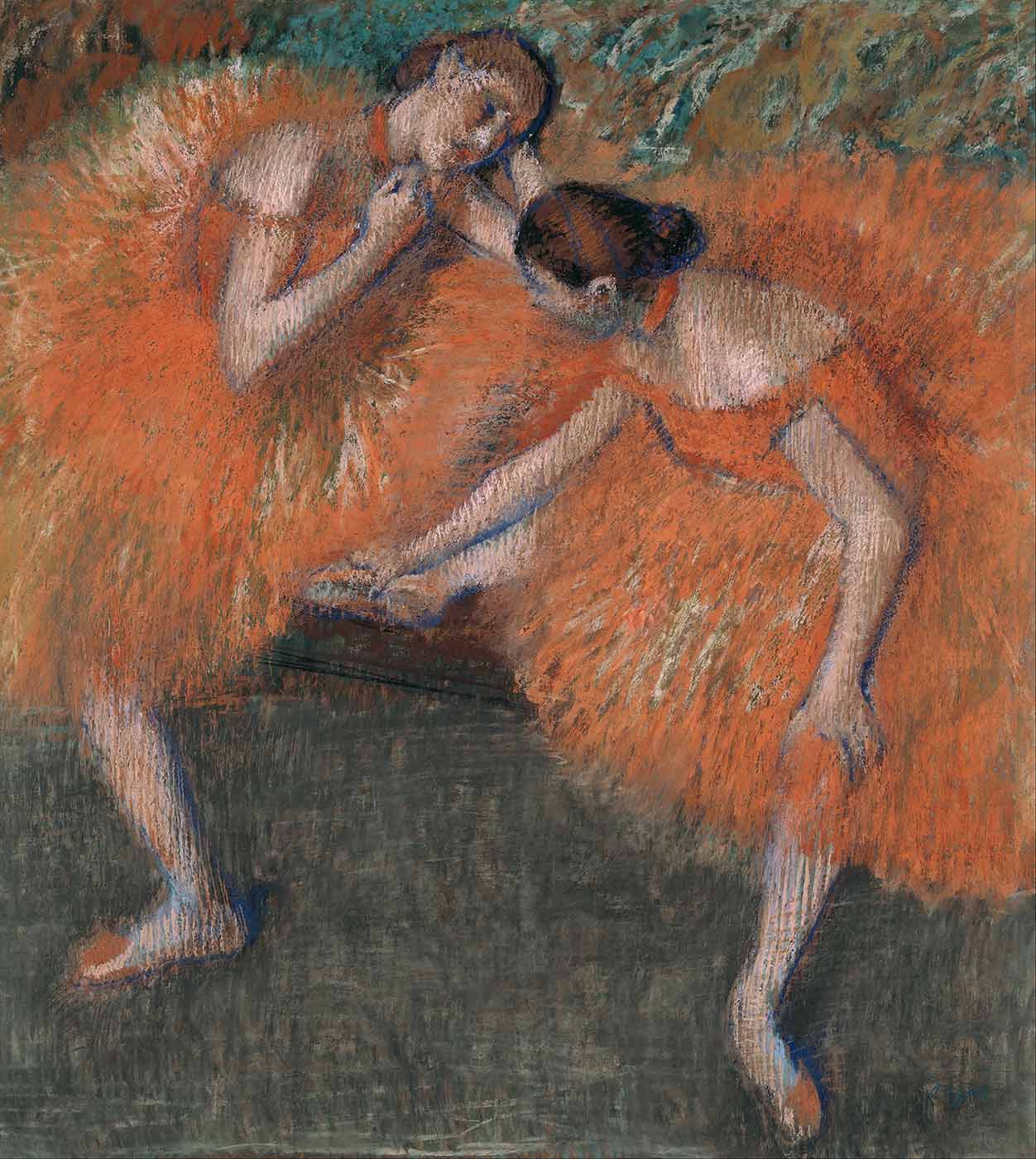
Two Dancers by Edgar Degas was created in 1898 and is in Albertinum Museum Dresden. The size of the work is 95,5 x 87 cm and is made of pastel on paper.
About the Artwork
For his numerous depictions of young Parisian dancers—often appearing as spontaneous snapshots captured from unconventional angles—Degas primarily employed pastels. To intensify the colors, he developed a unique technique: he would apply successive layers of chalk, securing each one with a specialized fixative. The result of this rigorous artistic process was a series of “pastel paintings” that would go on to serve as a model for many subsequent artists.
The Dresden work, which is nearly square in format, dates to around 1898—a period late in the artist’s career. Viewed from a slightly elevated perspective, the piece is striking for its close-up, full-frame composition. The slender bodies of the girls are almost entirely obscured by voluminous tulle skirts that extend beyond the edges of the image; the velvety, blended pink and orange tones of these skirts create an elegant contrast against the gray-brown dance floor in the foreground. Bold violet contour lines anchor the pastel strokes—which are broken down into minute color segments—within the overall form. The tension created by the graceful limbs and the elegantly inclined heads, integrated into an interplay of surface and line, serves to tighten and structure a composition that is conceived primarily in terms of two-dimensional planes.