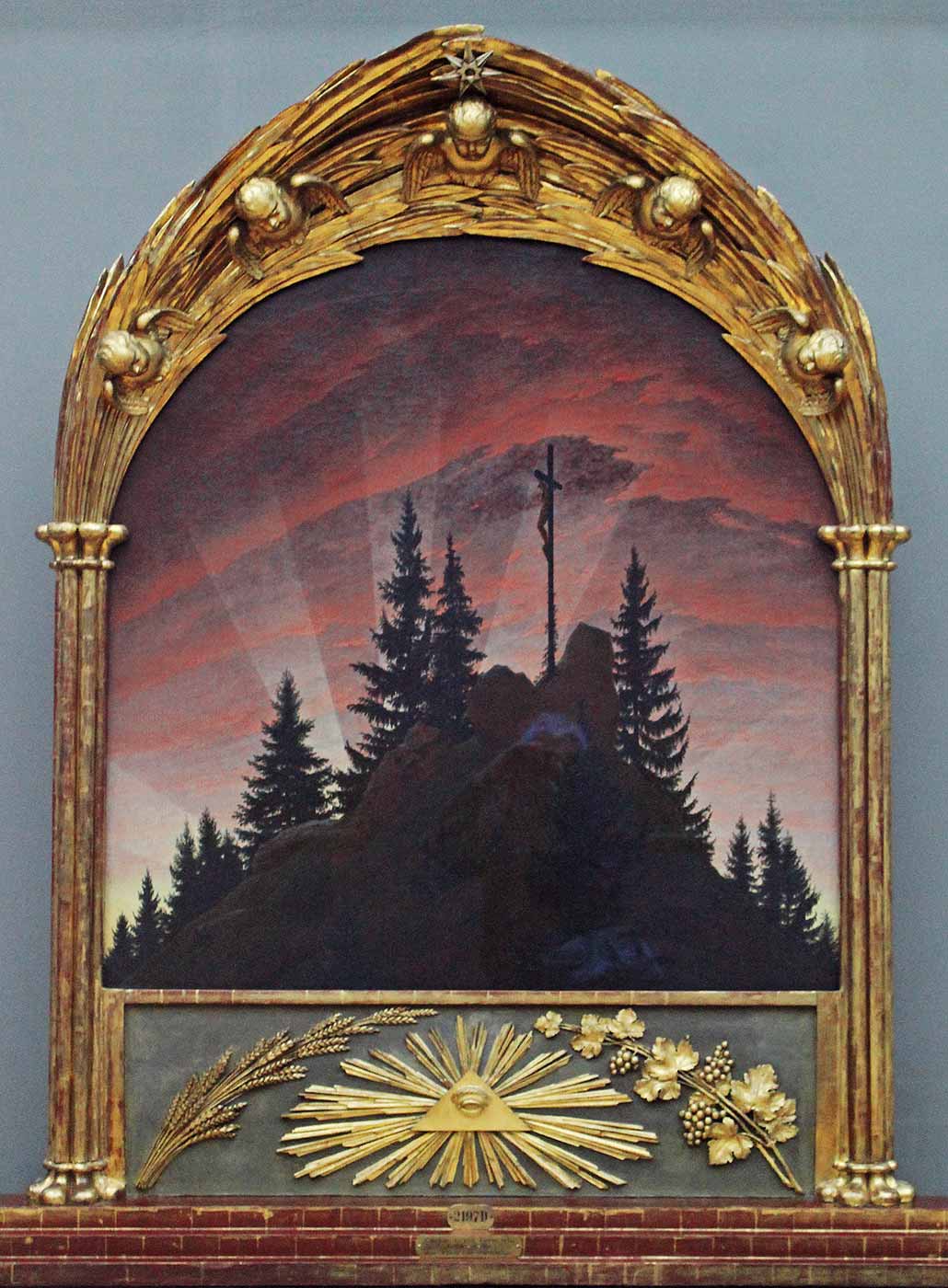
The Cross in the Mountains by Caspar David Friedrich was created in 1807/08 and is in Albertinum Museum, Dresden. The size of the work is 115 x 110 cm and is made of Oil on canvas, carved and gilded frame on a base.
When Caspar David Friedrich invited the Dresden public to his studio at Christmas in 1808, the work he exhibited there caused astonishment. With its frame covered in religious motifs, which the artist had designed himself, the work was easily recognisable as an altarpiece and inspired a quiet reverence among the people of Dresden. A bitter dispute soon ensued over the work, which broke with all tradition in its radically new form of landscape depiction. Instead of gentle plains stretching into the depths of the painting, a craggy peak rises from the centre of the picture, dramatically backlit by the rays of the setting sun.
The central focus of the painting, the summit cross, appears surprisingly small in comparison. With this work, Frederick expresses his Protestant faith, while also dedicating it as a political statement to the Swedish king who, as a Protestant ruler, fought against Napoleon, an aggressor whom Frederick despised. In 1809, the Thun-Hohensteins acquired the work for their castle in Děčín, hence the name „Tetschen Altarpiece”.