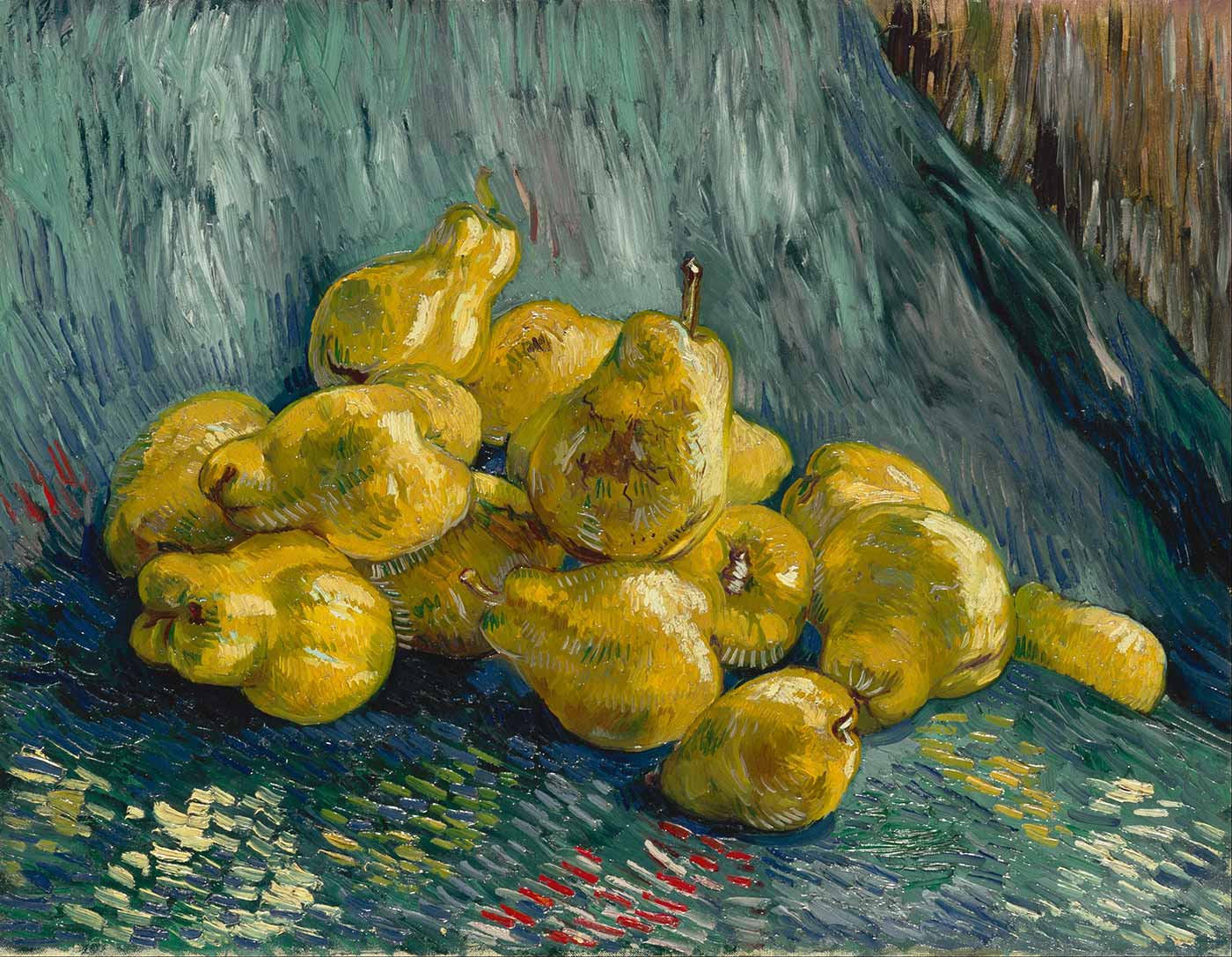
Still Life with Quinces by Vincent van Gogh was created in 1888 and is in Albertinum Museum, Dresden. The size of the work is 46 x 59,5 cm and is made of oil on canvas.
About the Artwork
“As for my own work, I had no money for models; otherwise, I would have devoted myself entirely to figure painting. But I did paint a series of color studies […] I sought to present the contrast between blue and orange, red and green, yellow and violet […].” (Vincent van Gogh, 1886). Still lifes consistently offered Van Gogh the opportunity to put into practice his theories—which aimed at heightening color intensity through the use of complementary tones. During his stay in Paris from 1886 to 1888, he also engaged intensively with the brushwork technique of Pointillism.
In his “Still Life with Quinces”—the condition of which, with minimal cracking in the paint layer, suggests a rapid, spontaneous execution—the primary focus is color. Variations of yellow, set in complementary gradations against blue-green tones, dominate a composition reduced to just a few elements. The color harmony is intensified by short, red brushstrokes, which in turn create a complementary contrast with the green-tinged turquoise-blue. Furthermore, gradations of white and brownish-violet enhance the luminosity of the hues. By employing subtle ochre-yellow outlines and omitting cast shadows, Van Gogh incorporated characteristic stylistic elements from Japanese color woodblock prints. The color fields, enlivened by dynamic, rhythmic brushstrokes, work against a sense of deep spatial recession; instead, they serve as a backdrop to amplify the vividness of the pear-shaped quinces—rendered with a tangible, three-dimensional quality through highlights and shadows, and viewed from a slightly elevated, close-up perspective. Together with the quinces, the vertically oriented yellow-brown-violet brushstrokes in the upper right corner provide a few subtle spatial accents.