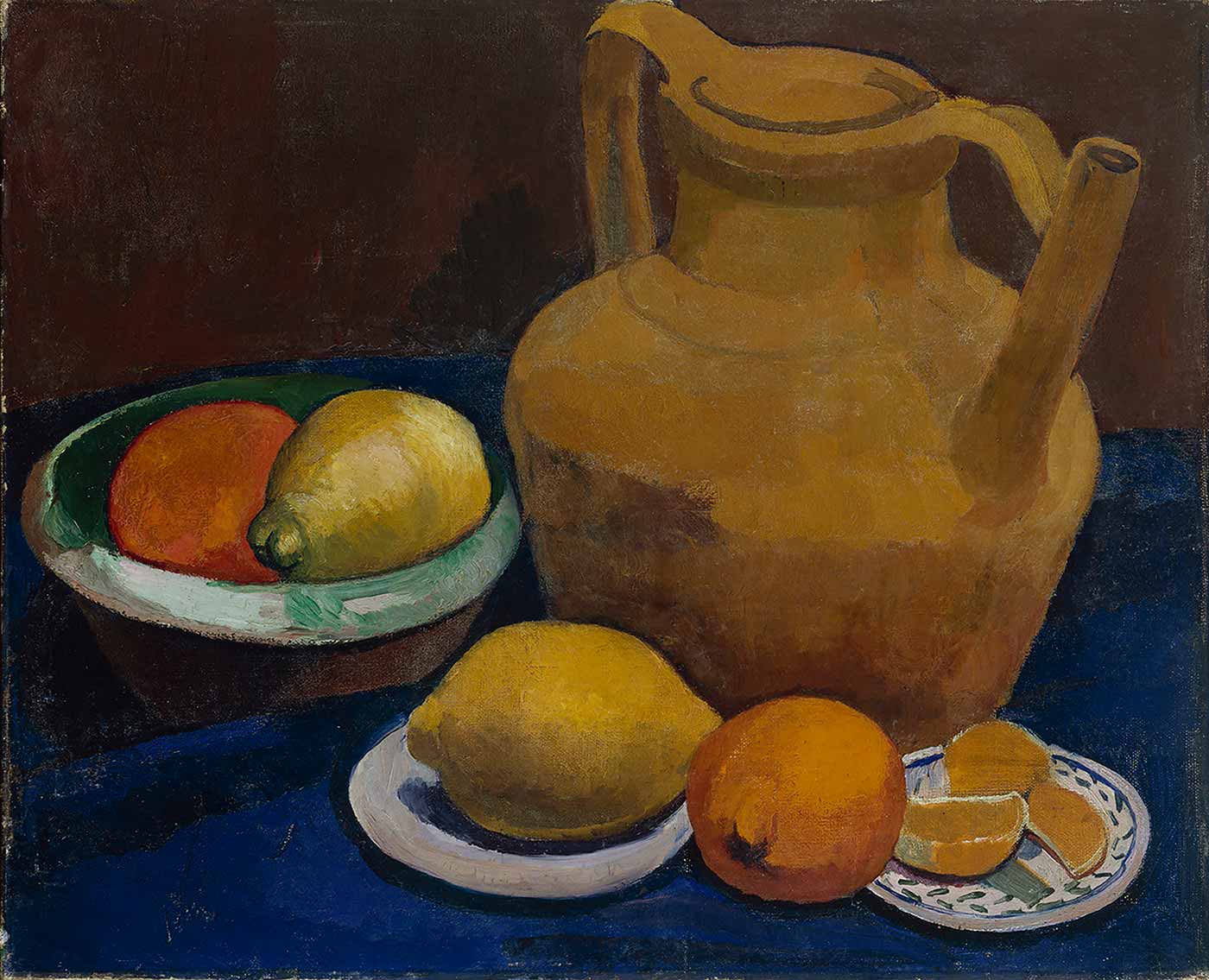
Still Life with Earthenware Jug Lemons and Oranges by Paula Modersohn Becker was created in 1906 and is in Albertinum Museum, Dresden. The size of the work is 38 x 47 cm and is made of oil on canvas.
About the Artwork
A still life-motif selection that the painter had already pursued intensively over the spring and summer literally ripened, in the fall of 1906, as it were. Lemons and an orange, the durable fruits with the thickly padded, smooth, porous skin, here in pairs, are placed next to a broad, two-handled, rustic, heavy clay jug. The intense, deeply saturated blue-violet of the cloth on the table makes the light-colored ceramic plates, in which the whole fruit and three segments of a peeled orange lie, glow with the greatest possible contrast. The green glaze, which fills the inside of a clay bowl arranged on the left, forms a complementary contrast to the orange of the orange, just as the purple is juxtaposed with the yellow of the lemons. Such bright, complementary contrasts were not found in the still lifes of the years before 1905: The artist herself found one of the most intense descriptions when she articulated in 1907: “I want to give the color the rushing, full, exciting, the powerful character.” (Busch/Reinken/Werner, 2007, p. 580)
In a clear, yet careful use of shadows, the volume of the jug and the fruit, in particular of the lemons, is visualized, without however subtracting from the glowing surface effect of the yellow and orange fields. The clarity of the adjacent color fields and the large scale of the objects within the composition lend the painting a quiet monumentality. Due to the clear drawing, the united round forms possess a rigidity and tranquility. The robust jug is not casually placed at the edge of the arrangement; instead, it majestically dominates the still life with its expansive volume and the upward diagonal of its spout. The fruit, equal to the jug in the warmth of their tones and the density of the paint application, seem to possess a tangible weight. Only the transparent orange segments rest almost playfully on the single plate with patterns. And yet they emphasize, perhaps precisely through this subtle counterplay, the dignity captured in the simplicity of things and the sublimely lifelike seriousness of Paula Modersohn-Becker’s nature morte painting.